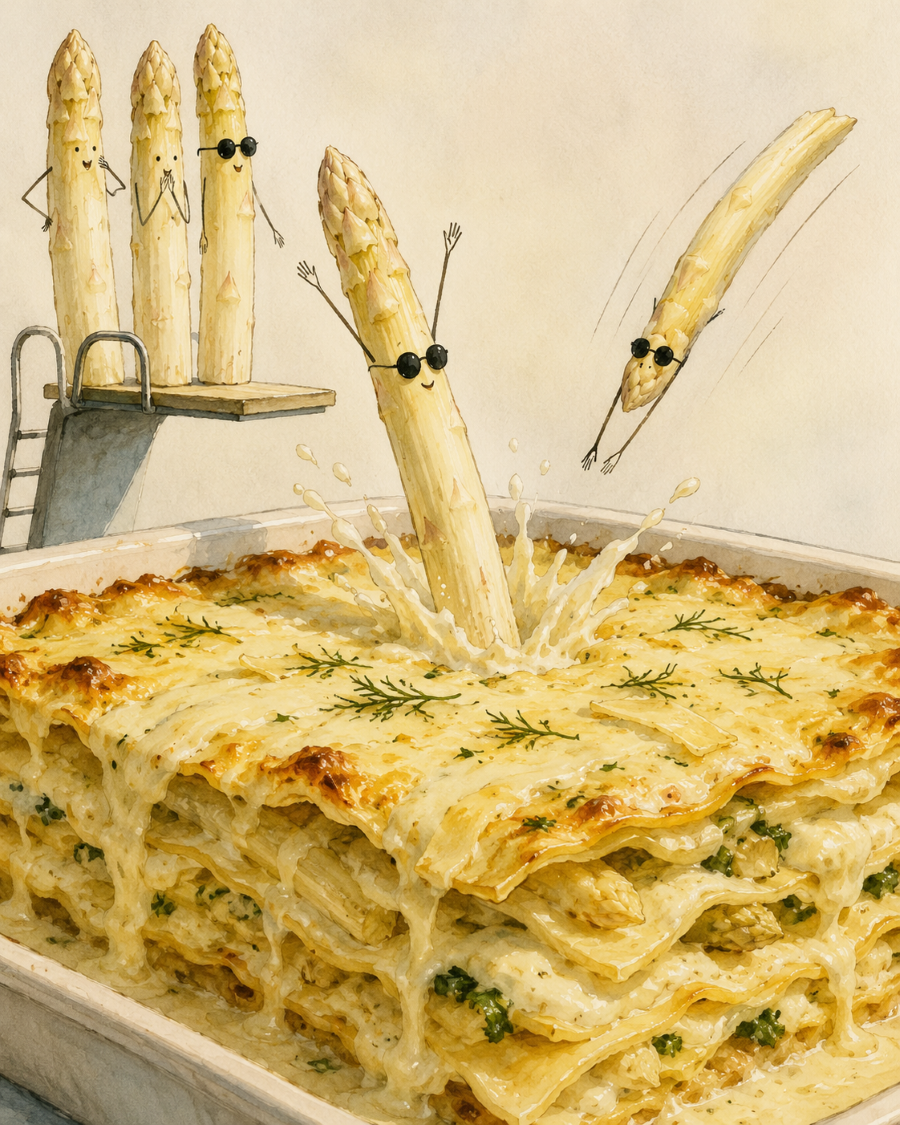
Some ingredients disappear long before we're ready to say goodbye.
White asparagus is one of them.
Its season arrives quietly and leaves just as quickly. One week the markets are full of beautiful pale stalks from Gotland, and before you know it, they have vanished until the following year.
This year we weren't quite ready to let them go.
Earlier in the season, while testing ideas for future lasagnas, we became fascinated by a particularly beautiful batch of white asparagus. They were delicate, juicy and remarkably crisp, the sort of ingredient that immediately starts a conversation in the kitchen.
Not about what to cook.
About how to make it last.
The solution turned out to be surprisingly simple. Water, white wine vinegar and a touch of sugar. Nothing more. The goal was never to transform the asparagus into something different, but simply to preserve what made it special in the first place.
Weeks later, in the middle of summer, one of the jars was opened.
The first bite brought us straight back to those spring mornings in the kitchen.
The asparagus still had its freshness. Its delicate sweetness. Most importantly, it had retained the gentle crunch that had impressed us from the beginning.
Almost immediately the conversation turned towards lasagna.
Not a traditional lasagna filled with tomato sauce and ragù. The preserved asparagus seemed to ask for something lighter, something that would allow it to remain at the centre of the dish.
A white lasagna slowly began to take shape.
The trimmings from the asparagus, saved from the original preparation, found their way into a béchamel. It was partly a way to avoid waste, but also a way to capture every bit of flavour hidden inside the ingredient. The result was an exceptionally silky sauce with a subtle asparagus character running through every spoonful.
Meanwhile, shallots were left to braise slowly until they became soft, sweet and deeply aromatic. Their richness settled into the lasagna like a quiet foundation, supporting the brighter notes of the asparagus without ever competing for attention.
Then came the Parmigiano Reggiano.
Generously.
Twenty-four months of ageing had transformed it into something far more complex than simply cheese. Nutty, savoury and deeply satisfying, it melted into the béchamel and disappeared between the layers, bringing depth and warmth to every bite.
As the lasagna baked, the kitchen filled with the kind of aroma that tends to attract people from other rooms.
What had started as an experiment in preserving asparagus was becoming something else entirely.
Something worth repeating.
Before serving, the lasagna received one final touch. A light vinaigrette made with trout roe and fresh dill.
The dill brought brightness.
The trout roe brought the sea.
The asparagus brought a memory of spring.
Together they created a dish that felt equally at home in Sweden and Italy, equally suited to a warm July evening as to the season that inspired it months before.
Perhaps that is the beauty of preserving ingredients.
They allow seasons to overlap.
A little piece of spring finds its way into summer.
And sometimes, that journey ends between layers of pasta.