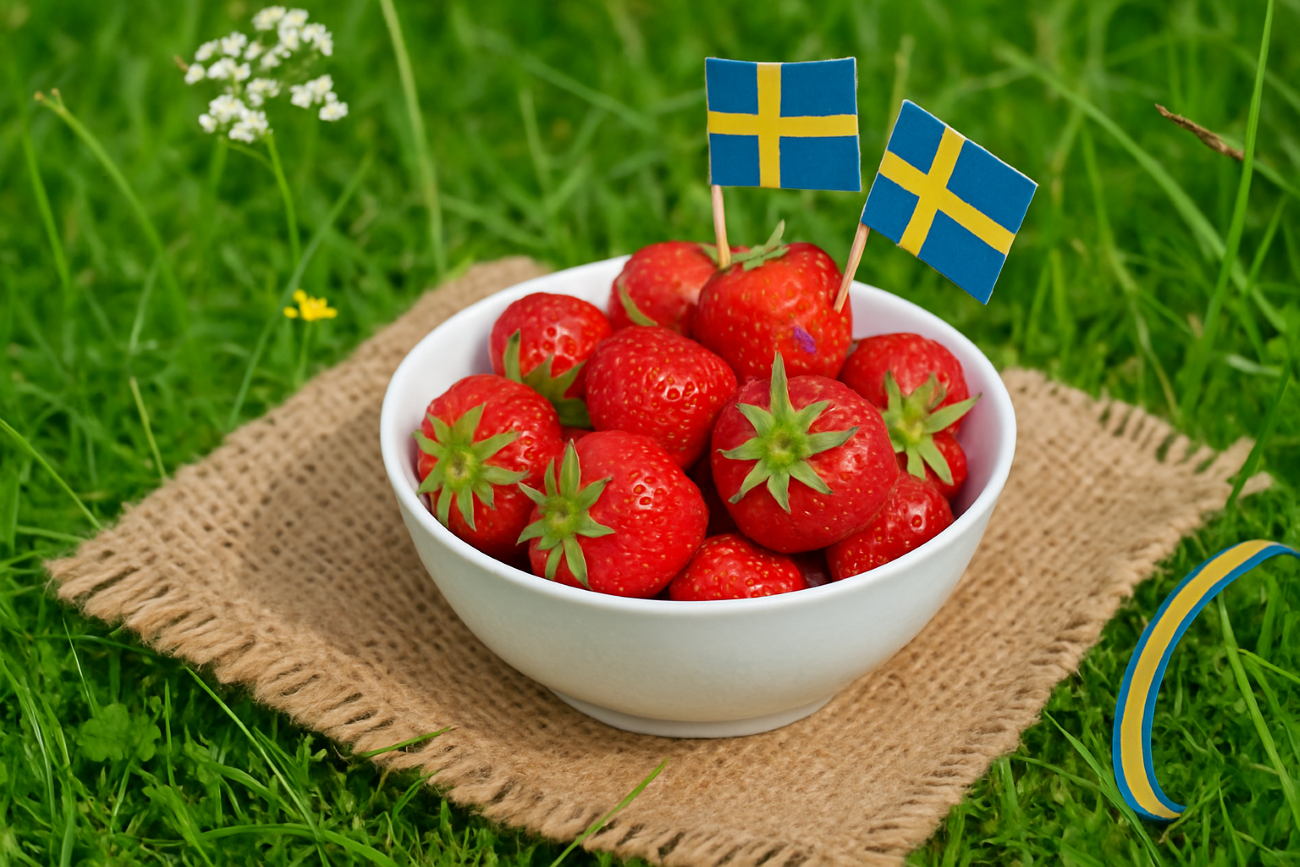
There is a moment, somewhere around midsummer, when everything in Sweden seems to slow down at once, as if the light itself is asking for a pause, and sometime late in the evening, when the sky turns soft pink and the air carries that quiet warmth that only exists for a few weeks a year, someone inevitably says, almost in a whisper, that the strawberries are ready.
And that is when it really begins.
Because Swedish strawberries are never just fruit; they arrive like a signal, a reminder that the long wait through darker months has paid off, that the sun has finally settled into place, and that it is now acceptable, almost expected, to slow down and let the days stretch out without too much structure. From that point on, fika changes slightly, becoming less about routine and more about the simple pleasure of something sweet, often served with cream and nothing else.
They appear everywhere at once, in markets and small shops, in cartons that look almost too fragile to carry, and yet carry something unmistakable within them, a smell that mixes earth, rain, and sunlight in a way that feels difficult to describe but easy to recognize. You queue for them without thinking too much about it, holding a small box that feels warmer than it should, already knowing that they will not last long.
Because they never do.
They are smaller than what you might expect, softer, more delicate, and far less interested in appearance than in flavor, and that is precisely what makes them stand out. There is a depth to them, something floral and bright at the same time, something that does not need sugar or decoration to feel complete, something that tastes as if it belongs exactly where you are when you eat it.
And perhaps that is the most important part.
Swedish strawberries are not made to travel, not designed to sit on shelves or survive long journeys, but to be eaten close to where they were grown, often with juice running down your fingers, often without much thought beyond the moment itself. You eat them now, because you know that soon enough they will be gone again, leaving behind only the memory of how they tasted.
Of course, there are other strawberries, other traditions, other ways of approaching the same fruit. In Italy, they arrive earlier, appearing in spring with a slightly different character, often served simply with a bit of lemon and sugar, sometimes even with a splash of wine, depending on where you are. They carry their own stories, shaped by place and habit, and like many things, they change slightly from one kitchen to another.
But even with that, there is something about Swedish strawberries in summer that feels complete in its own way, something that does not invite comparison so much as quiet appreciation.
And yet, as always, the question appears.
What does this have to do with lasagne?
At first, not much.
But then again, summer is rarely about strict logic.
It is about layers.
Sun-warmed shoulders, long meals that drift into evening, conversations that continue without needing direction, and food that fits into that rhythm rather than interrupting it. Somewhere in between those moments, a slice of lasagne finds its place, perhaps eaten warm, perhaps cold, perhaps straight from the container without ceremony, simply because it works.
Because good food, like good weather, does not need to be complicated.
After something savoury, though, there is always room for something else, something lighter, something that brings the day to a softer close, and that is where the strawberries return, this time not as a separate moment, but as part of the same experience.
A simple sauce, made from fresh berries, gently warmed or left as they are, with just enough sweetness to bring out their character without taking over, can do more than expected. It becomes something you reach for without thinking, something that feels refreshing and complete at the same time, something that tastes unmistakably like summer.
And sometimes, that is all it needs to be.
For those who grew up here, the memory is often tied to something even simpler: early mornings, fields that seem endless, baskets that are never quite big enough, and the quiet understanding that picking strawberries will always include eating more than you collect. Fingers turn pink, the sun stays high, and by the time you return, the basket is lighter than planned but somehow more satisfying.
For those new to it, the rhythm comes quickly.
Find a field, bring a container, pick slowly, taste often, and accept that part of the experience is not doing it perfectly. That, too, is part of the tradition.
And in a way, it mirrors how we think about food in general.
Not something to control too tightly, not something to overcomplicate, but something to engage with, to enjoy, to let unfold in its own time.
At Lasagnariet, that idea carries through everything we do, from the way we approach our hemlagad mat to how we think about what belongs on the table during different moments of the year. A meal does not need to be elaborate to feel complete; it only needs to feel considered, to be made with care, and to fit into the day rather than stand apart from it.
So perhaps the perfect summer meal is not a single dish, but a sequence.
Something fresh to begin with, something layered and comforting in the middle, and something simple and sweet to finish. Strawberries, in their season, take that final place naturally, without effort, without needing to prove anything.
Because like a well-made lasagne, they rely on time, on season, on letting things develop as they should.
You cannot rush them.
You cannot recreate them out of season.
You can only be there when they are ready.
And when they are, you take a moment, taste, and recognise it for what it is.
This is what summer feels like.
Not something grand.
Just something real.
So this week, we celebrate Swedish strawberries—not just as fruit, but as a ritual, as a memory, as a reminder that the best things do not last forever, and perhaps are better because of it.
From the kitchen, with care,
Lasagnariet