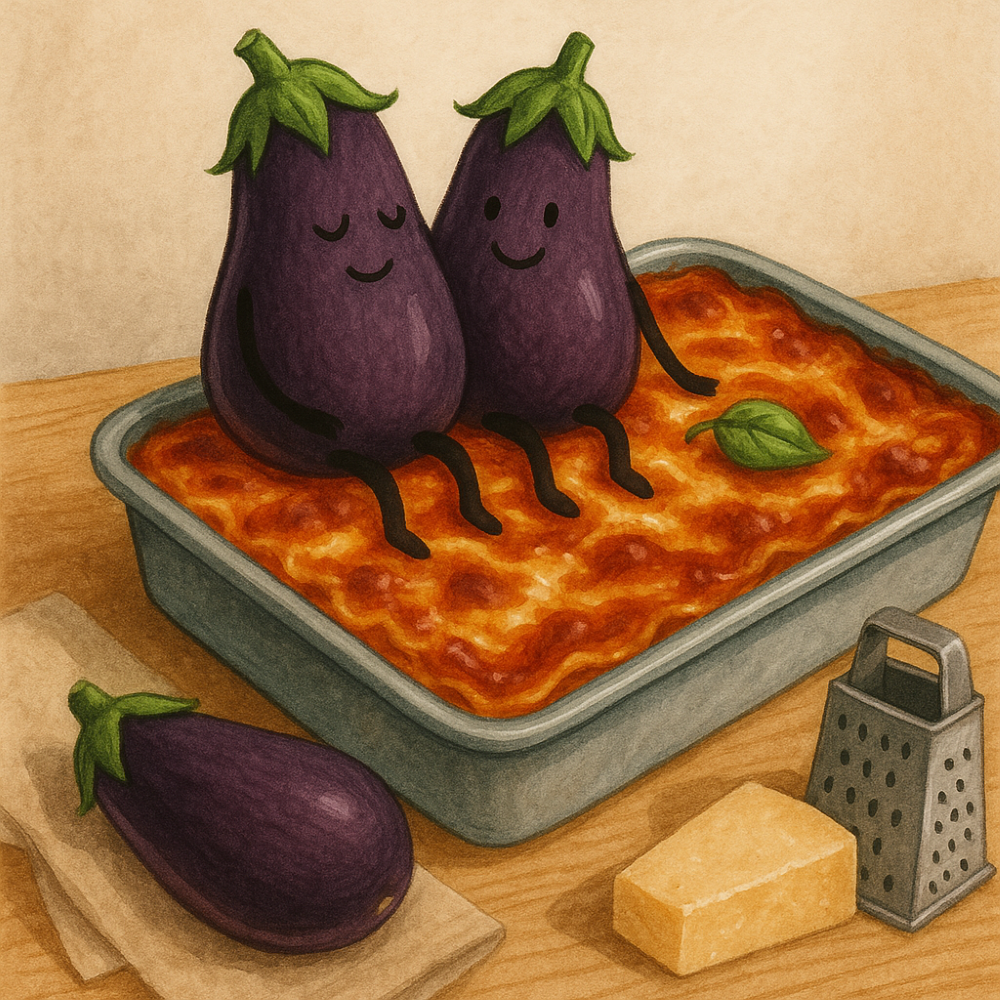
There is a moment in the kitchen when you pause without really planning to, holding an aubergine in one hand and a tray of fresh pasta in the other, and you realise that some decisions are not meant to be resolved so easily, because choosing between lasagne and parmigiana feels less like a choice and more like trying to separate two things that have always belonged to the same story.
And then, almost naturally, the question changes.
Not which one to choose, but what would happen if they were allowed to exist together.
Melanzane alla parmigiana has always carried a certain presence in Italian kitchens, not because it is complicated, but because it asks for time, for attention, for a kind of patience that you can recognise even before you see it, when the smell of tomato slowly cooking and aubergines softening in oil fills the space and reaches you long before the dish does. It is the kind of food that announces itself quietly but clearly, the kind that tells you something is being prepared properly, without shortcuts, without urgency.
Like many dishes that matter, it doesn’t belong to one place alone. It moves between regions, changes slightly depending on who is cooking it, and settles differently in each kitchen, so that over time it becomes less about origin and more about continuity, about how each person adds something small without ever losing what makes it recognisable.
That is exactly where the idea begins to take shape.
Because when something like parmigiana, built on softness and depth, meets the structure of lasagne, which is defined by its layers and its rhythm, the result is not a compromise but a continuation, a way of letting both identities remain intact while creating something that feels new without forcing it.
At Lasagnariet, that balance is not accidental.
It is something we return to again and again, allowing tradition to guide the process without letting it become rigid, and leaving space for the ingredients to adapt to where we are and what is available.
Aubergine, in this context, becomes more than just an ingredient, because it changes depending on how it is grown, when it is picked, and how it is treated, and while in Italy the variety can feel endless, here in Sweden it requires a different kind of attention, one that looks beyond what is immediately visible and instead focuses on what can be brought out of it.
Especially in summer, when the season, though short, carries an intensity that shapes everything it touches, aubergines begin to show a different character, one that may not always meet visual expectations but often carries more flavour, more depth, more presence, and it is those qualities that make them worth working with.
The preparation itself is not rushed, because it cannot be. The slices are salted and left to rest, allowing excess moisture to leave, then dried carefully before being cooked in a way that transforms them completely. Frying is not chosen by accident but because it changes the texture, giving the aubergine a softness and richness that becomes essential once the layers begin to form, even if alternatives like roasting remain possible for those who prefer a lighter approach.
What matters is not the method itself, but the result it creates.
Because once the aubergine meets the pasta, the béchamel, and the cheese, everything begins to settle into a balance that feels both familiar and complete, where no single element dominates but each one supports the others, creating a dish that holds together without needing to prove anything.
Even within that richness, there is still space for lightness, because comfort food, when done properly, does not need to feel heavy, it simply needs to feel right, and that is something more and more people are recognising, especially when it comes to vegetarisk mat, which has moved beyond being an alternative and instead become a natural choice in everyday life.
This shift is particularly visible in Stockholm, where the expectations around takeaway have started to change, and where convenience is no longer enough on its own, because people are looking for something that carries meaning as well as flavour, something that fits into their routines without feeling like a compromise.
That is where we find our place.
Not in speed or simplicity for its own sake, but in consistency, in the idea that each dish should feel considered, whether it is a classic lasagne, a version built around vegansk mat, or something adapted to be glutenfri, because the method remains the same even when the ingredients change.
Working with svenska råvaror is part of that approach, not as a statement, but as a natural decision, while certain Italian ingredients remain essential, not because they are traditional, but because they complete the flavour in a way that cannot easily be replaced, and together they form a balance that reflects both where the dish comes from and where it is being made.
In the end, the question was never really about choosing between lasagne and parmigiana.
It was about understanding what happens when both are allowed to exist in the same space, when layers are built slowly, when flavours are given time to settle, and when the result does not try to impress but simply to work.
And perhaps that is what makes it interesting.
Because nothing here is forced, nothing is exaggerated, and yet everything comes together in a way that feels complete, as if it had always been meant to exist like this.
One dish at a time, one layer at a time.
Only good lasagne.
Because life is made of layers.