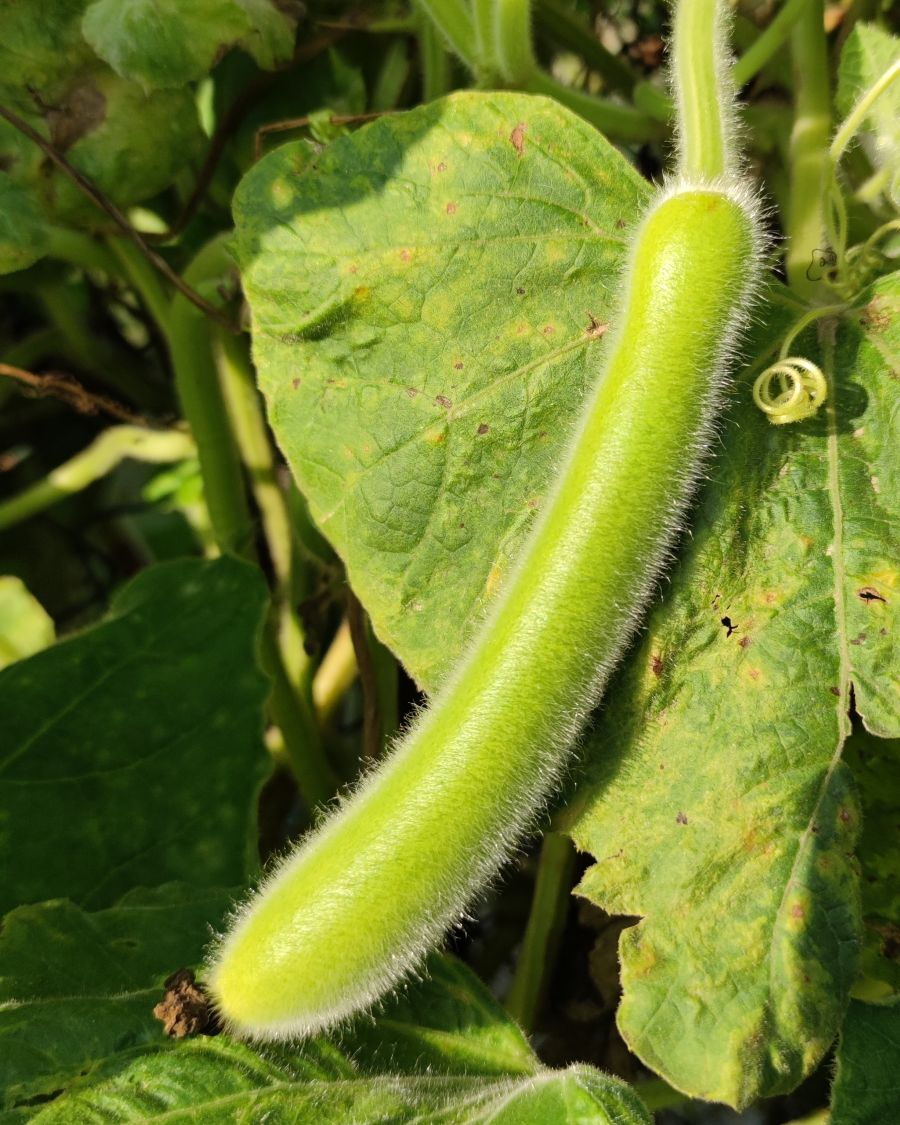
In Italy, zucchini season doesn’t really arrive quietly; it slowly takes over markets, gardens, and everyday cooking, bringing with it a wide variety of shapes, colors, and textures that reflect how something so simple can still feel endlessly different. Some are long and ribbed, others pale and soft, some slightly crooked as if they grew without any concern for symmetry, and over time you learn that none of that really matters, because the beauty of zucchini has never been in how it looks, but in how it tastes.
Arriving in Sweden, the contrast is noticeable. Zucchini appears more controlled, more consistent, usually limited to one or two varieties placed neatly on supermarket shelves, available all year round and almost too perfect in their uniformity. For a while, it feels like that’s simply how things are here, until one day, somewhere just outside Stockholm, that impression starts to shift.
At a small farm stand, without much structure or presentation, the vegetables tell a different story. There are zucchini with blossoms still attached, others shaped in unexpected ways, some too large, too curved, or too irregular to ever meet the standards of retail shelves. And yet, these are the ones that bring something back—the sense that vegetables can still carry the memory of the soil they grew in, that they can still feel alive in a way that doesn’t need to be explained.
At Lasagnariet, that’s exactly the kind of ingredient we are drawn to. Not the perfect ones, but the ones that feel real.
Working with zucchini in the kitchen became less about choosing the “right” variety and more about understanding what is available here, in this place, during this season. Sweden’s growing period may be short, but it has an intensity that shapes the ingredients in a particular way, and zucchini thrives in that window, full of water, full of freshness, needing very little intervention to become something memorable.
The process starts simply, with thin slices laid onto a hot surface, just enough heat to bring out a bit of color and concentrate the flavor without losing what makes the ingredient itself interesting. From there, it becomes part of something larger, layered carefully so that each piece keeps its identity while still contributing to the whole, because a good lasagne is never about hiding ingredients—it’s about allowing them to exist together.
Some zucchini varieties hold their structure better, giving definition to the layers, while others soften and almost dissolve into the sauce, creating a different kind of richness. Both have their place, and often the most interesting results come from combining them, rather than choosing between them. Still, the ones that stay with you tend to be the smallest ones, the ones that don’t quite fit expectations, slightly uneven, sometimes overlooked, but capable of absorbing flavor in a way that feels almost intentional.
As the dish begins to take shape, the question naturally shifts to what should accompany it. Basil is the expected choice, and for good reason, but zucchini has a delicate character that sometimes asks for something less obvious, something that creates contrast rather than simply reinforcing familiarity. Through testing and adjusting, different directions were explored, some more successful than others, until a combination emerged that felt balanced without being complicated.
Fresh mint, incorporated into a soft béchamel, brings a subtle lift that works with the sweetness of the zucchini rather than overpowering it. Layered together with grilled slices, melted mozzarella, and the deeper notes of sun-dried tomatoes, the result is a vegetarisk lasagne that feels connected to the season, something that belongs naturally in summer settings—on a picnic, at a long table, or as part of a meal that unfolds slowly over time.
This is where the meeting point becomes clear. Italian habits of cooking, rooted in patience and layering, come into contact with Swedish ingredients shaped by seasonality and local availability. The dough is prepared from scratch using local flour, vegetables are selected at their peak, and certain elements—olive oil, Parmigiano Reggiano—remain essential, not as a statement, but because they complete the balance of the dish in a way that feels necessary.
It has never been about choosing between local and traditional, but about understanding how both can coexist in a way that makes sense.
The same thinking applies to takeaway. It doesn’t have to mean speed at the expense of quality, or convenience without identity. It can still carry intention, still reflect care, still feel like something made by someone rather than produced by a system.
Stockholm’s food culture is moving in that direction. People still look for convenience, but increasingly they expect more—more depth, more transparency, more connection to what they are eating. They want food that fits into their lives without feeling like a compromise, whether it’s a quick lunch, a shared dinner, or something brought along to be enjoyed together.
That’s where we see our place.
Not as the fastest option, or the most accessible one, but as something consistent, something that people return to because it feels right. Every lasagne we prepare follows that same principle, whether it’s a classic version, a vegansk mat alternative, or a glutenfri variation. The approach doesn’t change—only the ingredients do.
This summer, zucchini naturally takes the lead. Roasted and layered with mint béchamel, mozzarella, and a generous finish of Parmigiano, it becomes something that feels both fresh and comforting at the same time, simple without being plain, familiar without being predictable.
And perhaps that’s what makes it interesting.
Zucchini has never tried to stand out, yet when given the right context, it doesn’t need to. It simply does what it does best, quietly becoming the center of the dish.
One imperfect vegetable at a time. One tray at a time.
Only good lasagne.
Because life is made of layers.